By Abhinav Chhabra, Ledger Brigade | 24 October 2026
Winning 501(c)(3) status is the start, not the finish. A public charity keeps its exemption only by filing the right return every year, issuing the right receipts, keeping its activities inside the rules and staying registered in every state where it raises money. Miss three years of filings and the IRS revokes the exemption automatically, with no letter beforehand.
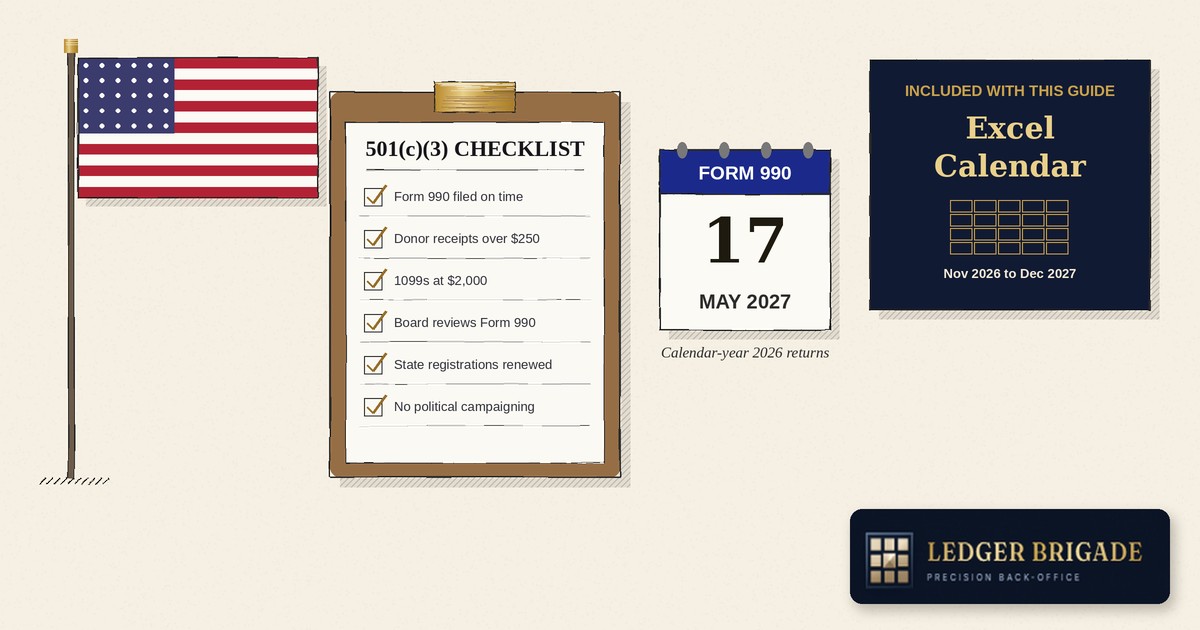
This guide sets out every recurring federal obligation for a US public charity, the changes that take effect in 2026, and the state items that catch organizations out. It comes with a compliance calendar in Excel covering 1 November 2026 to 31 December 2027, with every federal due date already adjusted for weekends and holidays.
501(c)(3) Compliance Calendar, November 2026 to December 2027 (Excel)
A dated calendar with a status column you can tick off, a Form 990 due date finder for any fiscal year-end, and a year-round checklist.
1. The annual return: which Form 990 do you file?
Almost every 501(c)(3) must file an annual information return with the IRS, even if it owes no tax. Which version depends on its size:
| Your organization | Return | How |
|---|---|---|
| Gross receipts normally $50,000 or less | Form 990-N (e-Postcard) | Online only; a few minutes |
| Gross receipts under $200,000 and total assets under $500,000 | Form 990-EZ (or the full Form 990) | Electronically |
| Gross receipts of $200,000 or more, or total assets of $500,000 or more | Form 990 | Electronically |
| Private foundation, whatever its size | Form 990-PF | Electronically |
Both limits matter for Form 990-EZ: an organization with $150,000 of receipts but $600,000 of assets must file the full Form 990.
Churches and certain church-related organizations are generally not required to file, but most other public charities are.
2. When it is due, and how to get more time
The rule: the 990-series return is due on the 15th day of the 5th month after the end of your tax year. If that day is a Saturday, Sunday or legal holiday, it moves to the next business day.
More time: Form 8868 gives an automatic 6-month extension for Forms 990, 990-EZ, 990-PF and 990-T, if you file it by the original due date. There is no extension for Form 990-N.
Here are the actual dates for the most common year-ends:
| Fiscal year ends | Original due date | Extended due date (with Form 8868) |
|---|---|---|
| 30 June 2026 | Monday 16 November 2026 | Monday 17 May 2027 |
| 30 September 2026 | Tuesday 16 February 2027 (15 February is Presidents' Day) | Monday 16 August 2027 |
| 31 December 2026 | Monday 17 May 2027 (15 May is a Saturday) | Monday 15 November 2027 |
| 31 March 2027 | Monday 16 August 2027 | Tuesday 15 February 2028 |
| 30 June 2027 | Monday 15 November 2027 | Monday 15 May 2028 |
The calendar includes a due date finder: type in any fiscal year-end and it calculates both dates, holidays included.
Penalties: a late Form 990 or 990-EZ attracts a daily penalty, indexed for inflation, with a higher daily rate for organizations with gross receipts above about $1 million. Filing an incomplete return counts as not filing.
The three-year rule
If an organization fails to file a required Form 990, 990-EZ or 990-N for three consecutive years, its tax exemption is revoked automatically on the due date of the third return. It must then apply again for exemption, and donations made in the meantime may not be deductible. Small organizations are the most common victims, because the 990-N is easy to forget.
3. Unrelated business income: Form 990-T
Income from a business that is regularly carried on and not substantially related to your mission (for example, advertising sold in a magazine, or a café run on commercial lines) is taxable, even for a charity.
- File Form 990-T if gross unrelated business income is $1,000 or more in the year. It is due on the same date as the Form 990 (15th day of the 5th month), and Form 8868 extends it.
- Pay estimated tax if you expect the tax to be $500 or more: four instalments, on the 15th day of the 4th, 6th, 9th and 12th months of the tax year (15 April, 15 June, 15 September and 15 December for a calendar year).
- An extension of time to file is not an extension of time to pay.
4. Payroll and information returns
If your organization has employees or pays contractors, these deadlines apply on top of the annual return:
| What | When (for 2026 payments) | Notes |
|---|---|---|
| Federal payroll tax deposits | By the 15th of the following month for monthly depositors; semi-weekly depositors follow their own schedule | Through EFTPS |
| Form 941 (quarterly payroll return) | 2 November 2026 (third quarter), 1 February 2027 (fourth quarter), then 30 April, 2 August and 1 November 2027 | Dates already moved for weekends |
| Form W-2 to employees and the SSA | 1 February 2027 | 31 January 2027 is a Sunday |
| Form 1099-NEC to contractors and the IRS | 1 February 2027 | Only for contractors paid $2,000 or more in 2026 (up from $600) |
| Form 1099-MISC | Recipient copies 1 February 2027; IRS by 1 March 2027 (paper) or 31 March 2027 (electronic) | Rents, prizes and most other payments: $2,000 or more in 2026 (gross proceeds paid to attorneys stay at $600, royalties at $10). Paper filing only if you file fewer than 10 information returns in total |
The $2,000 threshold comes from section 70433 of the One Big Beautiful Bill Act, which amended both section 6041(a) and section 6041A of the Internal Revenue Code. It will be indexed for inflation from 2027. Some states still require 1099s at $600 for state purposes, so check your state's rules.
Good news on unemployment tax: 501(c)(3) organizations are exempt from federal unemployment tax (FUTA), so they do not file Form 940. State unemployment insurance still applies, although many states let nonprofits reimburse actual claims instead of paying contributions.
Worker classification matters as much for a charity as for a business: treating an employee as a contractor creates back payroll taxes and penalties.
5. Donors: receipts and disclosures
Donor paperwork is where many small charities slip, and the rules are strict:
- Gifts of $250 or more: the donor cannot deduct the gift without a written acknowledgment from you, received before they file. It must state the amount (or describe non-cash property) and say whether you gave anything in return, and if so, a good-faith estimate of its value.
- Quid pro quo payments over $75 (a gala dinner, an auction item, a concert): you must give a written statement explaining that only the amount above the value of what the donor received is deductible, with your good-faith estimate of that value.
- Donated vehicles worth more than $500: give Form 1098-C to the donor within 30 days of the sale (or of the contribution, in some cases).
- Selling donated property (other than publicly traded securities) that the donor valued above $5,000, within three years of the gift: file Form 8282 within 125 days of the sale.
What changed for donors in 2026
The One Big Beautiful Bill Act changed the charitable deduction from 1 January 2026, and it affects what your donors will ask for:
- Non-itemizers can deduct cash gifts again: up to $1,000 for single filers and $2,000 for married couples filing jointly. Gifts to donor-advised funds do not qualify. Expect more small donors to ask for receipts.
- Itemizers face a 0.5% floor: the first 0.5% of a donor's adjusted gross income in gifts is not deductible.
- Corporate donors face a 1% floor: corporate gifts are deductible only above 1% of taxable income (and still capped at 10%).
What to do: make sure every receipt shows the date, the cash amount and the "no goods or services" statement, and send annual giving statements by the end of January.
6. Governance and public disclosure
The Form 990 asks about governance in detail (Part VI), and the answers are public. Before you file, check that:
- the board meets and keeps minutes, and reviews the Form 990 before it is filed;
- directors, officers and key employees sign an annual conflict-of-interest statement, and conflicts are handled under a written policy;
- compensation of officers and key employees is approved using comparable pay data and documented when decided;
- whistleblower, document retention and gift acceptance policies exist and are current.
Public inspection: you must make your last three Forms 990 (and any Form 990-T), your exemption application (Form 1023 or 1023-EZ) and your IRS determination letter available to anyone who asks. Public charities do not have to disclose the names and addresses of donors listed on Schedule B.
Keep the IRS updated: report a change of responsible party on Form 8822-B within 60 days, and report name and address changes.
7. Activities that can cost you the exemption
- Political campaigns: a 501(c)(3) must not support or oppose any candidate for public office, directly or indirectly. There is no "small amount" exception.
- Lobbying: allowed only if it is not a "substantial part" of your activities. Many organizations elect the section 501(h) expenditure test (Form 5768), which replaces that vague standard with dollar limits.
- Private benefit and excess benefit transactions: paying an insider more than fair value (salary, rent, a sale of property) triggers excise taxes on the insider and on managers who approved it, and in serious cases threatens the exemption.
8. Staying a public charity: the public support test
A 501(c)(3) is presumed to be a private foundation unless it shows broad public support. Most public charities pass the test on Schedule A of Form 990: generally, at least one-third of total support over a five-year period must come from the public, or at least 10% with facts and circumstances showing a public character. Track the percentage every year: a few years of support from a single large donor can push you towards private foundation status, which brings stricter rules.
9. State compliance
Federal exemption does not cover state obligations, and these differ in every state:
- Charitable solicitation registration: around 40 states require registration before you ask their residents for donations, with annual renewals and fees, often linked to your Form 990.
- Annual reports to the Secretary of State to keep the nonprofit corporation in good standing.
- State copies of Form 990 or state forms (for example, California's Form RRF-1 or New York's CHAR500).
- State tax exemptions: income or franchise tax, sales tax and property tax exemptions, some of which need renewal.
- Grant reporting: organizations spending $1,000,000 or more of federal awards in a fiscal year beginning on or after 1 October 2024 need a Single Audit.
Giving days and platforms: the example of Colorado Gives
Online giving platforms and giving days now bring in a large share of many charities' year-end gifts, and they come with compliance conditions of their own. Colorado Gives is a good example: run by the Colorado Gives Foundation, ColoradoGives.org hosts more than 4,000 Colorado nonprofits, and Colorado Gives Day 2026 is Tuesday 8 December, with early giving from 1 November.
- State registration is a condition of taking part. ColoradoGives.org requires 501(c)(3) public charity status plus a current Certificate of Registration and Certificate of Good Standing from the Colorado Secretary of State. If your charitable solicitation registration or corporate filing lapses, you can lose your place on the platform in the busiest weeks of the year, so check both before November.
- Know who issues the receipt. Colorado Gives Foundation emails the donor a tax receipt for each donation it processes, so do not send a second receipt for the same gift. A thank-you letter is fine, as long as it does not read as another receipt.
- Reconcile the disbursements. Platform gifts arrive in batches: ColoradoGives.org pays out within 15 business days after each month-end, and gifts made between 1 and 8 December arrive by 31 December, together with any prizes and the Incentive Fund share. Match each disbursement to the platform's donation report so every gift is recorded once, and record prizes and incentive payments as revenue.
The same three questions apply to any giving day or donation platform in other states: what registrations it requires, who receipts the donor, and how and when the money reaches you.
10. What you no longer need to file
Beneficial ownership (BOI) reports to FinCEN: on 11 August 2026, FinCEN issued a final rule permanently exempting all US-formed entities from reporting beneficial ownership information. Most nonprofits were exempt anyway; now no US-formed organization has to file.
11. The calendar at a glance: November 2026 to December 2027
| Date | What is due |
|---|---|
| 2 November 2026 | Form 941 for July to September 2026 |
| 16 November 2026 | Extended 2025 Form 990 / 990-T for calendar-year filers; original Form 990 for 30 June 2026 year-ends |
| 15 December 2026 | Form 990 for 31 July year-ends; fourth 990-T estimate for 2026 |
| 8 December 2026 | Colorado Gives Day (early giving from 1 November), for Colorado nonprofits on ColoradoGives.org |
| 31 December 2026 | Year-end: record 2026 gifts; collect W-9s from 2026 contractors |
| 1 February 2027 | Forms W-2 and 1099-NEC ($2,000 threshold); Form 941 for October to December 2026; donor statements for 2026 gifts (by 31 January) |
| 16 February 2027 | Form 990 for 30 September 2026 year-ends |
| 1 March / 31 March 2027 | Form 1099-MISC to the IRS (paper / electronic) |
| 15 April 2027 | First 990-T estimate for 2027 |
| 17 May 2027 | Form 990, 990-EZ, 990-N and 990-T for calendar year 2026, or Form 8868 for an extension |
| 2 August 2027 | Form 941 for April to June 2027; Form 5500 for calendar-year benefit plans |
| 15 November 2027 | Extended 2026 Form 990 / 990-T; original Form 990 for 30 June 2027 year-ends |
| 15 December 2027 | Fourth 990-T estimate for 2027 |
The calendar lists all 55 dated items, including monthly payroll deposits, every fiscal year-end and the Colorado Gives Day dates.
Download the calendar (Excel, 119 KB)
Frequently asked questions
We are tiny and raised under $50,000. Do we really need to file?
Yes. Form 990-N takes minutes, but skipping it three years in a row revokes your exemption automatically.
Can we get an extension for the Form 990-N?
No. Form 8868 extends Forms 990, 990-EZ, 990-PF and 990-T, but not the 990-N.
Does a 501(c)(3) pay federal unemployment tax?
No. 501(c)(3) organizations are exempt from FUTA and do not file Form 940. State unemployment rules still apply.
Do we have to send 1099s to every contractor?
Only to those paid $2,000 or more in 2026 for services (the threshold was $600 before 2026). Collect a Form W-9 from every contractor when you first pay them.
Who can see our Form 990?
Anyone. You must provide the last three returns on request, and they are published online. Donor names and addresses on Schedule B are not public for public charities.
Complimentary compliance diagnostic for nonprofits. Not sure where your organization stands? Ledger Brigade offers US nonprofits a complimentary compliance diagnostic: we review your filing history and current Form 990 position, your donor receipting and your year-end payroll and 1099 readiness, and send you a short written list of gaps and next steps. Book your diagnostic or email hello@ledgerbrigade.com.
Need help?
Ledger Brigade's US team, overseen by qualified US CPAs, keeps nonprofit books, prepares payroll and information returns, and builds the records your Form 990 preparer needs, from donor receipts to the public support schedule. Start with a complimentary compliance diagnostic: email hello@ledgerbrigade.com or book a briefing.
Which deadline catches your organization out most often? Tell us in the comments.
Important information. This article and the compliance calendar are general information about US federal requirements for 501(c)(3) public charities, stated as at 24 October 2026. They are not tax, legal or accounting advice, and reading the article or using the calendar does not create an adviser-client relationship with Ledger Brigade. Tax rules and deadlines change, and the IRS often postpones deadlines for organizations in federally declared disaster areas, so confirm each date on IRS.gov before relying on it. State requirements differ and are described only in general terms. Private foundations, churches, and organizations with unusual activities (such as significant unrelated business, foreign activities or benefit plans) may have obligations not covered here. Always consult a qualified tax adviser or attorney about your organization's specific obligations before acting. Ledger Brigade accepts no liability for decisions made on the basis of this general information. The complimentary diagnostic is a general review. It does not include preparing, reviewing, signing or filing any return, and it does not create an engagement until both sides agree one in writing.
Sources
- IRS, Form 990 overview course and Publication 557, Tax-Exempt Status for Your Organization (filing thresholds, due dates, Form 8868 extension, automatic revocation).
- IRS, Instructions for Form 990-T and Publication 598 (unrelated business income: $1,000 filing threshold, due dates, estimated tax).
- IRS, General Instructions for Certain Information Returns (Form 1099 due dates; electronic filing for 10 or more returns); One Big Beautiful Bill Act, section 70433 ($2,000 threshold for Form 1099-NEC and most Form 1099-MISC payments made after 31 December 2025).
- IRS Publication 1771, Charitable Contributions: Substantiation and Disclosure Requirements; Forms 1098-C and 8282 instructions.
- One Big Beautiful Bill Act (Public Law 119-21), changes to sections 170 (non-itemizer deduction, 0.5% and 1% floors) effective 2026.
- FinCEN final rule of 11 August 2026 on beneficial ownership reporting.
- 2 CFR 200.501 (Single Audit threshold).
- Colorado Gives Foundation, ColoradoGives.org help centre (eligibility and state filing requirements, tax receipts, 2026 disbursement dates) and press release of 15 October 2026 (Colorado Gives Day 2026).
Comments (0)
Be the first to comment.
Leave a comment