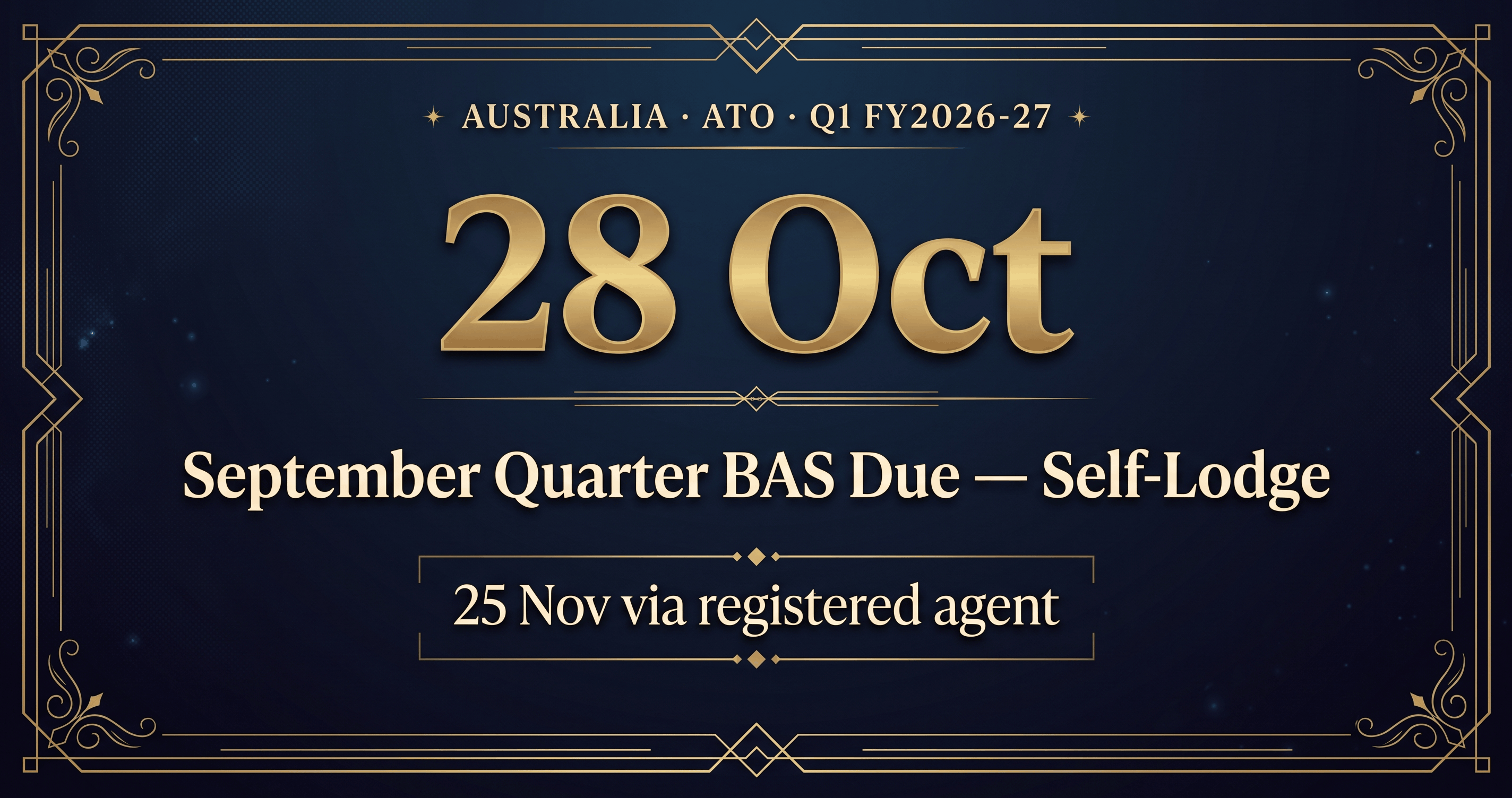
The September quarter closed on 30 September 2026. If you lodge your own BAS, it is due to the ATO by 28 October. If you use a registered tax agent, the extended deadline is 25 November.
This is the first full quarter of the financial year, and the first full quarter operating under the Payday Super rules that came into effect on 1 July. That makes the PAYG and super sections of this BAS more important to reconcile carefully than usual.
GST: Code It Correctly, Not Approximately
Before lodging, reconcile your GST-coded transactions in your accounting software against your bank statements for the quarter. The most common BAS errors at this time of year are miscoded transactions: GST-free items coded as taxable, or capital purchases coded as operating expenses.
If your software has unreconciled bank transactions from the quarter, do not lodge with estimated figures. An amended BAS carries a higher compliance risk than a slightly late original one.
PAYG Withholding: Match to STP Data
The W1 (wages) and W2 (PAYG withheld) figures on your BAS must reconcile to what you have reported through Single Touch Payroll. If your STP data and your BAS figures don't match, the ATO's systems will flag the discrepancy, and the resolution process is considerably more time-consuming than getting it right the first time.
For quarterly reporters, confirm that every payroll event from July, August, and September has been finalised and submitted through your STP-enabled payroll software before you complete the PAYG section of the BAS.
Super: Per Pay Period Under the New Rules
Under Payday Super (effective from 1 July 2026), superannuation is now remitted per pay period rather than quarterly. Your BAS does not report super directly (super is tracked through the ATO's employer reporting system) but your bookkeeping records should show super accruals and payments per payroll run, not as a single quarterly entry.
If your accounts still show super as a quarterly lump sum, that is a signal that your payroll and bookkeeping processes have not been updated for the new rules. Address this before your year-end close, not after.
PAYG Instalments: Review the Amount
If you pay PAYG income tax instalments, Q1 is the time to review whether your instalment amount is tracking correctly against your expected annual income. If your income has changed materially from the prior year, varying your instalment amount now (rather than at Q4) reduces the end-of-year adjustment.
Varying your instalment carries a shortfall penalty if you underestimate by more than 15%. Only vary if the movement in your income is genuine and documented.
Q1 Pre-Lodge Checklist
- Bank reconciled to 30 September, all transactions coded and matched.
- GST review: check high-value transactions and any new expense categories for correct tax codes.
- W1/W2 cross-check: reconcile BAS PAYG figures to STP data from your payroll system.
- Super records: confirm remittances show per-pay-period, not quarterly lump sums.
- PAYG instalments: review Q1 instalment versus YTD income and vary only if warranted.
General information only. BAS requirements and ATO deadlines are subject to change. Consult a registered BAS agent or tax agent for guidance specific to your situation.
Comments (0)
Be the first to comment.
Leave a comment